Category: English

  • Ceramic Coating vs PPF: Which Should You Choose?

    Ceramic Coating vs PPF: Which Should You Choose?

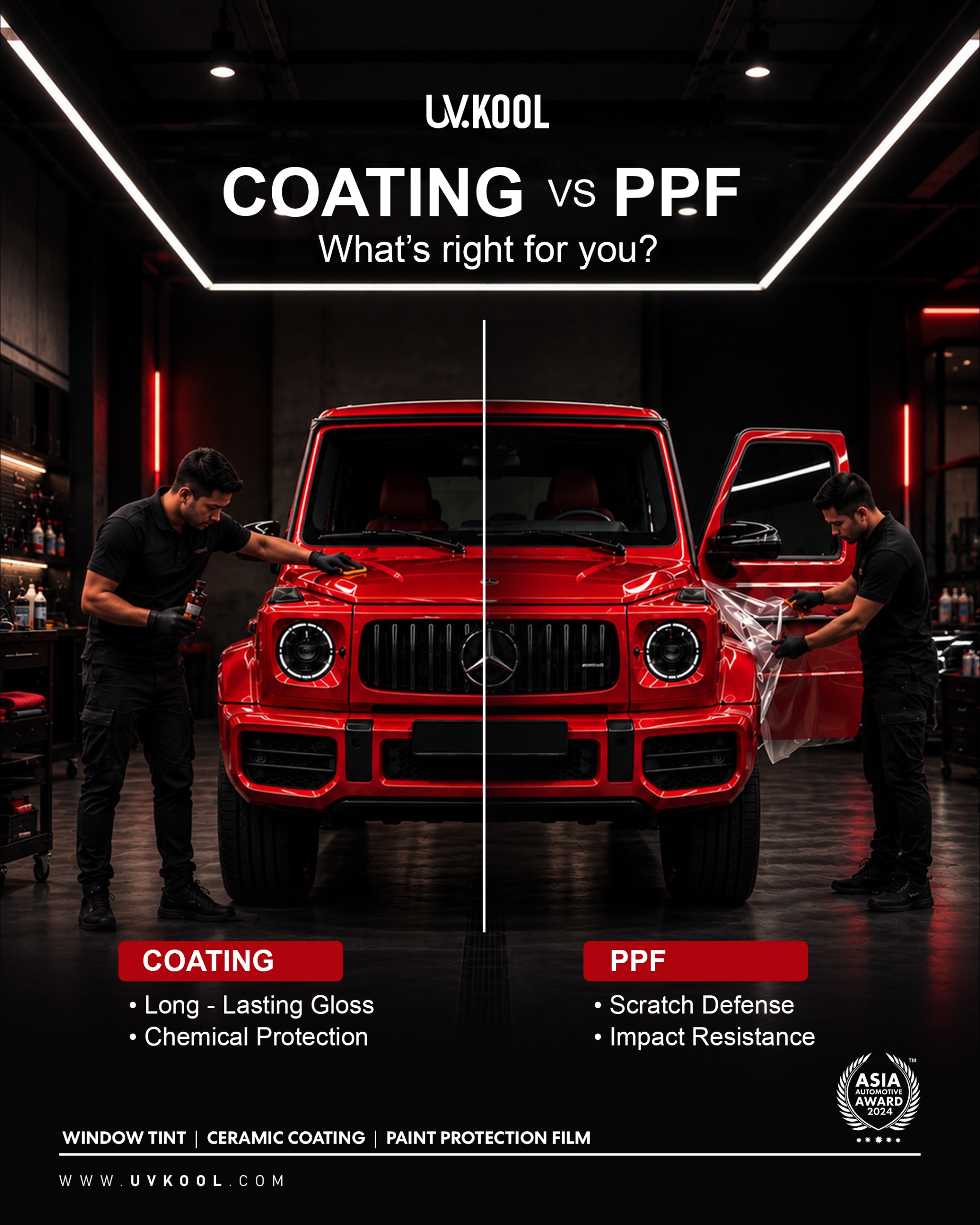
    Ceramic coating vs PPF is one of the most common questions car owners ask when they want to protect their paint. Both protect the paint, but in very different ways, so here is a simple guide to help you choose.

    Baca dalam Bahasa Malaysia: Coating vs PPF: Apa Beza dan Mana Lebih Sesuai?

    The short answer

    PPF (paint protection film) is a physical shield against stone chips and scratches. Ceramic coating is a thin chemical layer that adds gloss, repels water and makes the car easier to clean. One resists impact, the other keeps the paint looking glossy and clean, and many owners use both.

    What is ceramic coating?

    A liquid applied to the paint that cures into a hard, glossy layer. It makes water and dirt slide off, makes washing easier and gives the paint a deeper shine. It also helps protect the surface from UV, bird droppings and water spots. Because it is very thin, it does not stop stone chips and offers only modest protection against scratches.

    What is PPF?

    A clear, flexible film applied over the paint panels. It absorbs small impacts from stones and road debris and guards against light scratches. Many films also have a top layer that helps light swirl marks fade with heat. If it gets damaged, the film can be replaced without touching the paint underneath.

    Ceramic coating vs PPF at a glance

    Ceramic coating PPF
    Stone chips Little to no protection Good protection
    Light scratches Modest protection Better protection
    Gloss and shine Strong boost Keeps the paint looking original
    Water beading, easy washing Excellent Good, better with a coating on top
    Cost Usually lower Usually higher
    If damaged Reapply the coating Replace the film panel

    Prices and warranty depend on the brand, the car size and how many panels you cover, so always confirm the details with your installer.

    Which should you choose?

    • Daily highway driver? Choose PPF on the bonnet, front bumper, mirrors and fenders, where stone chips happen most.
    • Want a showroom shine with easy washing? Choose ceramic coating.
    • New car and want the best protection? Combine them: PPF on high-impact panels and ceramic coating on the rest, or on top of the film.
    • Tight budget? Start with ceramic coating, and add PPF on the front later.

    Do not forget the glass

    Both options protect the paint only. For heat, UV and glare inside the cabin, you need window tint. See our guide on the best window tint for heat in Malaysia, and check how dark car tint can be in Malaysia before you choose a shade.

    Talk to us

    Not sure what suits your car? Message the outlet nearest you on WhatsApp: Johor Bahru, Kulai, Bandar Tiram, Kajang or Bandar Saujana Putra.

    FAQ

    Is PPF better than ceramic coating?

    For stone chips and scratches, yes. For gloss and easy cleaning, ceramic coating is excellent. They do different jobs.

    Can I put ceramic coating on top of PPF?

    Yes, many owners do this to make the film easier to wash and to add water beading.

    Does ceramic coating stop scratches?

    It helps against very light marks, but it is not scratch-proof and does not stop stone chips.

    Which lasts longer?

    It depends on the product, the quality of installation and how you care for the car. Ask your installer for the warranty terms.
  • SmartTag Friendly Car Tint in Malaysia: Which Films Work

    SmartTag Friendly Car Tint in Malaysia: Which Films Work

    Looking for a SmartTag friendly car tint in Malaysia? Some window films can weaken the signal of your Touch ‘n Go SmartTAG, GPS and Bluetooth. Here is how to choose a film that keeps all three working.

    Baca dalam Bahasa Malaysia: Tint Kereta Serasi SmartTag

    Why tint can affect SmartTAG

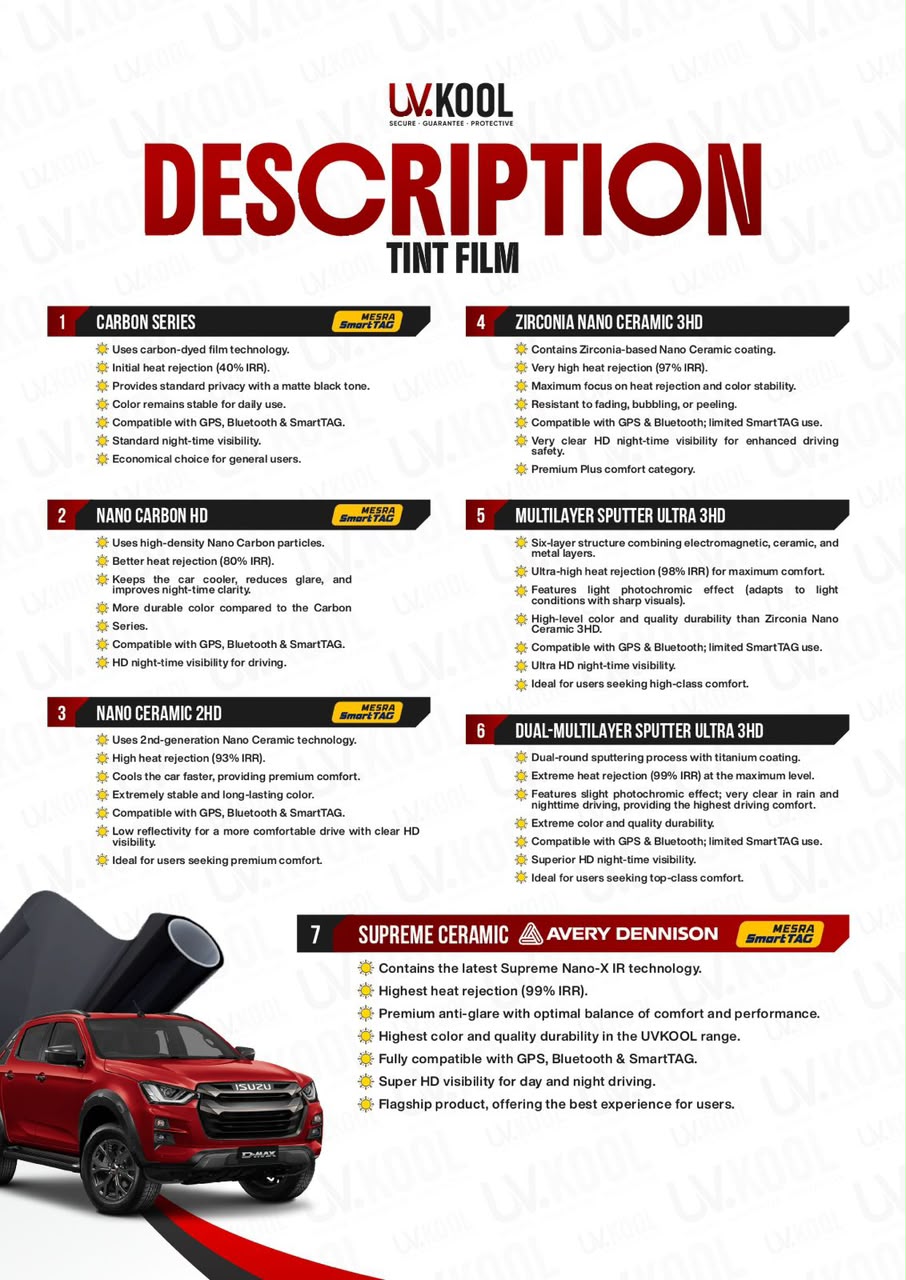
    SmartTAG, GPS and Bluetooth all rely on radio signals passing through your glass. Films with a lot of metal content can block part of that signal. Carbon and ceramic films contain little or no metal, so they are the safer choice.

    UVKOOL films and SmartTAG compatibility

    Film Heat rejection SmartTAG
    Carbon Series 40% IRR Compatible
    Nano Carbon HD 80% IRR Compatible
    Nano Ceramic 2HD 93% IRR Compatible
    Supreme Ceramic (Avery Dennison) 99% IRR Fully compatible
    Zirconia Nano Ceramic 3HD 97% IRR Limited use
    Multilayer Sputter Ultra 3HD 98% IRR Limited use
    Dual-Multilayer Sputter Ultra 3HD 99% IRR Limited use

    All of them work with GPS and Bluetooth. The difference is SmartTAG on the premium sputter and zirconia films, which has limited use.

    Which one should you pick?

    • Budget: Carbon Series gives standard privacy and works with SmartTAG.
    • Best value: Nano Carbon HD gives 80% heat rejection and a 4-year warranty.
    • Premium comfort: Nano Ceramic 2HD gives 93% heat rejection with low reflectivity.
    • Top of the range: Supreme Ceramic by Avery Dennison gives 99% heat rejection and stays fully SmartTAG-friendly.

    If you want the strongest heat rejection and a working SmartTAG, Supreme Ceramic is the one to look at. See how the films compare on heat in our window tint for heat guide.

    Windscreen rules still apply

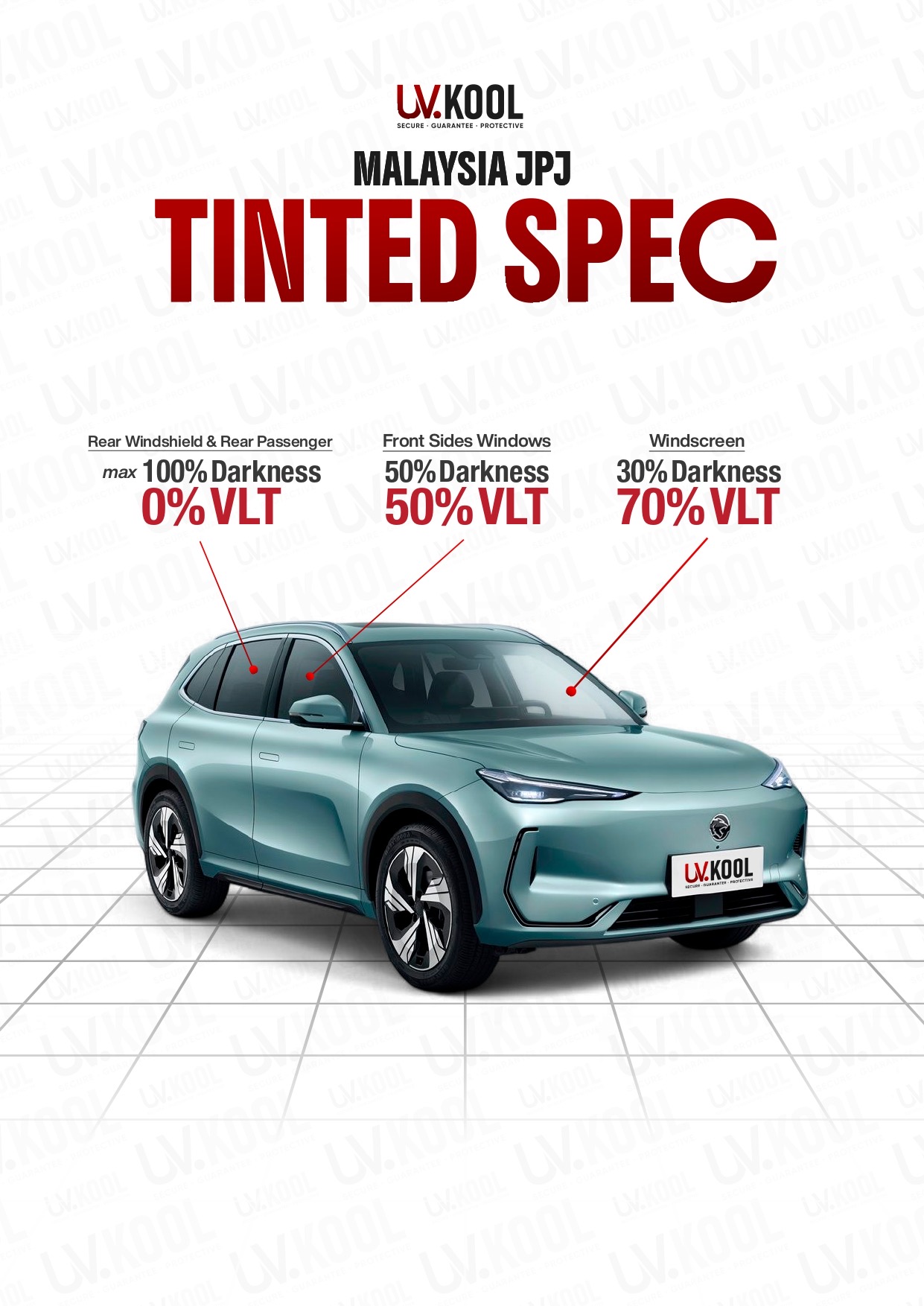
    Your SmartTAG sits on the front windscreen, where JPJ requires a minimum of 70% VLT. Read the full limits in how dark can car tint be in Malaysia.

    Do you have to give up heat rejection?

    No. Many drivers assume a stronger film means a weaker SmartTAG signal. With UVKOOL you can pick a premium film and still keep your tag working. Supreme Ceramic by Avery Dennison reaches 99% IRR and is listed as fully compatible with GPS, Bluetooth and SmartTAG. Nano Ceramic 2HD gives 93% IRR and is also compatible.

    The films with limited SmartTAG use are Zirconia Nano Ceramic 3HD (97% IRR), Multilayer Sputter Ultra 3HD (98% IRR) and Dual-Multilayer Sputter Ultra 3HD (99% IRR). They are excellent for heat and clarity, but they suit drivers who do not rely on SmartTAG.

    Warranty and value at a glance

    • Carbon Series: 2-year bubble warranty.
    • Nano Carbon HD: 4-year warranty.
    • Nano Ceramic 2HD: 5-year warranty.
    • Supreme Ceramic: lifetime warranty.

    If you use the highway every day, a SmartTAG-friendly film saves you from carrying a second solution. Choose it once and forget about it.

    Tips before you tint

    1. Tell the installer that you use SmartTAG, GPS or Bluetooth devices.
    2. Check your tag is stuck properly on the windscreen before and after the job.
    3. Choose a film from the compatible list if SmartTAG matters to you daily.
    4. Ask the outlet to confirm the film on your car, especially if you want a premium sputter film.

    FAQ

    Will tint stop my SmartTAG from working?

    Carbon and ceramic films are SmartTAG-friendly. Zirconia and sputter films have limited SmartTAG use, so ask before choosing them.

    Does tint affect GPS and Bluetooth?

    All UVKOOL films are compatible with GPS and Bluetooth.

    I already have a sputter film. What now?

    Visit an outlet and the team can check your setup.

    Visit a UVKOOL outlet

    Johor Bahru | Kulai | Bandar Tiram | Kajang | Bandar Saujana Putra

    Open any outlet page above to WhatsApp the team and book your tint.

  • Best Window Tint for Heat in Malaysia: Carbon vs Nano Ceramic vs Sputter

    Best Window Tint for Heat in Malaysia: Carbon vs Nano Ceramic vs Sputter

    Baca dalam Bahasa Malaysia: Tint Kereta Tahan Panas di Malaysia

    Malaysia’s sun is no joke. If you’re looking for the best window tint for heat in Malaysia, the shade of the film matters less than its heat rejection. A dark film can still let heat through, while a lighter one can block much more.

    Dark does not mean cooler

    Two numbers matter more than how dark a tint looks:

    • IR rejection: how much infrared (heat) the film blocks.
    • UV rejection: how much UV the film blocks. All UVKOOL window films reject 99% UV.

    So when comparing films, look at IR rejection first, then clarity, warranty and signal compatibility.

    Carbon: the everyday option

    Carbon film has a deep black finish and resists fading. It is non-metallic, so GPS, radio and mobile signals keep working normally.

    • Carbon Series: 40% IR rejection, 2 years bubble warranty
    • Nano Carbon HD: 80% IR rejection, 4 years bubble warranty

    Best for: drivers who want a good-looking, signal-friendly tint at a lower budget.

    Nano ceramic: clear view, strong heat rejection

    Nano-ceramic particles reduce infrared heat while keeping the view clear. The film is non-metallic, non-reflective and colour-stable.

    • Nano Ceramic 2HD: 93% IR rejection, 5 years bubble warranty
    • Zirconia Nano Ceramic 3HD: 97% IR rejection, 6 years bubble warranty, lifetime colour warranty, blue light rejection
    • Supreme Ceramic by Avery Dennison: 99% IR rejection, lifetime warranty, blue light rejection

    Best for: daily drivers who spend long hours in traffic and want a cooler cabin.

    Sputter: built for demanding conditions

    Sputter films are made with multiple layers applied using a sputtering process.

    • Multilayer Sputter Ultra 3HD: 98% IR rejection, 8 years bubble warranty, lifetime colour warranty
    • Dual-Multilayer Sputter Ultra 3HD: 99% IR rejection, 10 years bubble warranty, lifetime colour warranty

    Best for: owners who want top heat rejection and the longest bubble warranty.

    Quick comparison

    FilmIR rejectionBubble warrantySmartTag
    Carbon Series40%2 yearsFriendly
    Nano Carbon HD80%4 yearsFriendly
    Nano Ceramic 2HD93%5 yearsFriendly
    Zirconia Nano Ceramic 3HD97%6 yearsNot friendly
    Multilayer Sputter Ultra 3HD98%8 yearsNot friendly
    Dual-Multilayer Sputter Ultra 3HD99%10 yearsNot friendly
    Supreme Ceramic (Avery Dennison)99%LifetimeFriendly

    Figures are from UVKOOL’s film listings. Warranty coverage is subject to package terms.

    Don’t forget SmartTag

    If you use SmartTag on your windscreen, check compatibility before choosing. Some high-performance films are not SmartTag-friendly, so tell us how you use your car and we’ll recommend a film that works.

    And keep it legal

    Whatever film you choose, the front windscreen and front side windows must still follow JPJ’s VLT limits. Read our guide: How Dark Can Car Tint Be in Malaysia?

    Which one should you choose?

    • Budget-friendly and signal-friendly: Carbon Series or Nano Carbon HD
    • Balanced heat rejection and clarity: Nano Ceramic 2HD
    • High performance: Zirconia Nano Ceramic 3HD or the Sputter range
    • Premium and SmartTag-friendly: Supreme Ceramic by Avery Dennison

    Window tint for heat: quick answers

    Which film rejects the most heat?

    Dual-Multilayer Sputter Ultra 3HD and Supreme Ceramic by Avery Dennison both list 99% IR rejection.

    Does a darker tint block more heat?

    Not necessarily. Heat rejection depends on the film’s IR rejection, not only how dark it looks.

    Do all films block UV?

    Yes. All UVKOOL window films reject 99% UV, and the difference between them is in heat rejection, clarity and shade.

    Which films are SmartTag-friendly?

    Carbon Series, Nano Carbon HD, Nano Ceramic 2HD and Supreme Ceramic by Avery Dennison.

    Visit a UVKOOL outlet

    See the films in person at UVKOOL Johor Bahru, Kulai, Bandar Tiram, Kajang and Bandar Saujana Putra. Tell us your car model and our team will help you choose.

    Tak pasti tint mana sesuai? WhatsApp outlet berdekatan anda melalui page outlet di atas untuk cadangan dan quotation.

  • How Dark Can Car Tint Be in Malaysia? (JPJ VLT Rules Explained)

    How Dark Can Car Tint Be in Malaysia? (JPJ VLT Rules Explained)

    Thinking of getting your car tinted? The big question is: how dark can car tint be in Malaysia? Before you choose a shade, it helps to know what JPJ actually allows. The wrong tint can mean a summons, and nobody wants to redo their tint.

    What is VLT?

    VLT stands for Visible Light Transmission. It is the percentage of light that passes through your window after tinting.

    • Higher VLT = lighter tint
    • Lower VLT = darker tint

    So a 70% VLT tint is light, while a 20% VLT tint is dark.

    How dark can car tint be in Malaysia? JPJ limits by window

    WindowMinimum VLT
    Front windscreen70%
    Front side windows (driver and passenger)50%
    Rear side windows and rear windscreenNo limit

    The front is regulated for visibility, especially at night and in heavy rain. The rear has no VLT limit under current JPJ rules.

    Don’t forget factory glass

    Many cars already have slightly tinted glass from the factory. Your tint film is applied on top, so the final combined VLT is what counts. A film that looks legal on paper can still go over the limit once it’s on the glass.

    How to check your tint is legal

    1. Ask the installer to measure with a VLT meter on each window.
    2. Ask for a post-installation check so you can see the reading.
    3. Choose a reputable shop that explains the numbers openly.

    Can you get an exemption?

    JPJ allows exemption applications for certain medical or security reasons. If you think you qualify, apply to JPJ first before tinting darker than the limit.

    Car tint FAQ

    What is the VLT limit for the front windscreen?

    The front windscreen needs at least 70% VLT, and the front side windows at least 50%.

    Can I tint the rear windows as dark as I want?

    Under current JPJ rules, the rear side windows and rear windscreen have no VLT limit.

    Why can a legal-looking tint still fail a check?

    Factory glass already has some tint. The final combined VLT of film and glass is what gets measured.

    Can I apply for an exemption?

    Yes, for certain medical or security reasons. Apply to JPJ before tinting darker than the limit.

    How long is a tint warranty?

    It depends on the film. At UVKOOL, the film options carry bubble warranties from 2 years up to 10 years, subject to the terms of the package you choose. Ask our team for the details before you decide.

    Is a darker tint cooler?

    Not necessarily. How dark a film looks (VLT) is different from how much heat it blocks. Heat rejection is measured by IR (infrared) rejection. For example, UVKOOL’s Carbon Series rejects 40% IR, while Nano Ceramic 2HD rejects 93% IR. So a lighter, JPJ-legal film with high IR rejection can block more heat than a darker film with low IR rejection. When you compare films, look at IR rejection and UV rejection, not only how dark the film looks.

    Common mistakes when tinting your car

    • Choosing a film only because it looks dark, without checking heat rejection.
    • Forgetting that factory glass already has some tint.
    • Not asking for a VLT reading after installation.

    These mistakes are easy to avoid if you ask the right questions before you decide.

    Tips before you tint

    • Ask for a VLT reading on every window after installation.
    • Compare IR rejection and warranty, not only price or darkness.
    • Ask whether the film is SmartTag-friendly if you use SmartTag.
    • Keep your warranty details and receipt, and read the warranty terms.
    • Choose an installer who explains the film options clearly.

    Taking a few minutes to ask these questions helps you avoid redoing your tint later.

    Which tint should you choose?

    Legal doesn’t mean the same quality. Look at heat rejection, UV protection and warranty, not only how dark the film looks. Our team can explain the options based on your car model and how you use it.

    Based in Johor Bahru? See our car window tinting in Johor Bahru page for film options, opening hours and directions.

    Tak pasti tint mana sesuai? WhatsApp kami untuk cadangan dan quotation.

    Baca artikel ini dalam Bahasa Malaysia: Had Gelap Tint Kereta di Malaysia